Saturday, May 28, 2016

Greetings from Iloilo!

Our next stop during our excursion was Iloilo. We boarded an early morning flight to the city from Manila. Noticeably different from Manila, Iloilo seems to be more sustainable in terms of their agricultural structure. Nonetheless, it's still a bustling city like Manila that even New York traffic couldn't compare too. 

Sister Corey was our guide for the day. She is a native of Iloilo, so it's was only fitting that she toured us around the city that she knows so well. She took us to visit her home where we would be able to visit her mother. A woman of wisdom and stunningly beautiful, she made sure all 12 of her children received a degree. I hope to be as resilient as her at age 95. We were also able to visit the school she attended where we met student leaders and toured the facility. 

Later in the day we were finally greeted by our borrowers at Colegio de San Jose! They came baring beautiful shell necklaces for us as a welcome to the Philippines. So far I've noticed that before all of our meetings, we first join together in prayer. This has been a great way to unite us together before our discussions.  During our meeting, they each shared a presentation of their businesses that depicted before and after photos, pictures of their meetings, and an overview of where the business is now. The presentations were so well put together. Despite being able to speak little English, they each stood up to express their gratitude to us. Although we may not have been able to understand each other's dialect, I believe that thank you is universal.  As thankful as they were to us is as thankful as we were to them. They were a group of strong women who expressed that they wanted to be able to educate their children with the income from their businesses. They didn't want them to work on an island but rather attain a degree. In that sense, I believe that GLOBE's impact will be generational. 

Our next stop is Legazpi, stay tuned!


The Tale of Two Cities


Yes, both of these places are in Manila, but they have very little in common. This is the tale of two cities.

Generally, we believe that we are all equal. We cringe at the sight of any form of discrimination and even protest when our own rights are violated. However, is equality just a concept in today’s world? Each example of social and economic inequality reminds us of George Orwell’s statement that some people “are more equal than others” (I hope you’re familiar with Animal Farm). One of the first things they teach us in Economics is that limited resources are matched with unlimited wants. The sad reality of this is that the majority is forced to live in a state of desolation so that the rich can satisfy their unlimited wants.


Day two introduced us to two sides of the same city with the help of our dear friends at Habitat for Humanity, an international NGO dedicated to providing housing for the world’s poor. It is their vision to have “a world where everyone has a decent place to live.” One of Habitat’s thriving operations is housing microfinance. Although they do not provide microfinance services on their own, they develop partnerships with microfinance institutions such as Kasagana-ka Development Center Inc, which provides microloans, savings, insurance and education for the urban poor.


The day’s activities began with a brief overview of Kasagana-ka’s business objectives and operations.


You may read about poor communities in books, see them in the news, or discuss them with colleagues, but the complexion of the poverty problem is quite different when you experience it first-hand. Kasagana-ka, alongside with Habitat for Humanity, plunged us head first into one of the communities they serve – just in time for a borrower repayment meeting. The streets were paved with debris of all kinds. We were greeted by the smell of poor sanitation and pestilence, along with hungry stray animals. As we walked through the neighborhood, we witnessed the daily lives of those deprived of the luxuries we often take for granted.


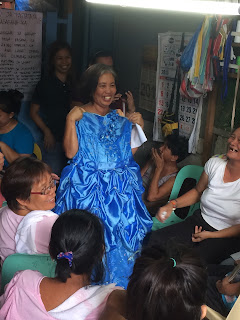
Nevertheless, the attitudes of the people reminded us of the important distinction between ‘poor’ and ‘living in poverty’. As we listened to Kasagana-ka’s borrowers welcome us and share their delight and enthusiasm, it was clear that they are by no means ‘poor’. They emulated a sense of hope and solidarity that many ‘rich’ persons would love to experience. The repayment meeting was not just a formality to collect loan funds. It was a home of unity among the borrowers. They share joy and support each other in every aspect of life. The strength of this community and the dedication of the borrowers allow Kasagana-ka to boast a 100% loan repayment rate – how impressive!


I was told that the other side of Manila is “much more Westernized,” but it was as though we travelled to a different land. During the drive to the main office of Habitat for Humanity, we encountered an unbelievably different city. It felt like New York (well..somewhat). I wondered if I was still in the Philippines! Just over an hour away by car, the buildings pierced the sky; the residents were dressed for office; the culture painted a different picture.


Fortunately, there are organizations such as Habitat for Humanity that are making strides in alleviating poverty and hopefully tipping the balance of inequality. Inside the office, we were introduced to a lot of the impactful work that Habitat is performing in the Asia-Pacific area and beyond. 

Incremental Housing; Housing Microfinance; The MicroBuild Fund; what does this all mean for the poor? Incremental housing reminds me of Lao Tzu’s words: “The journey of a thousand miles begins with a single step.” This is the process whereby repairs and improvements can be made to homes- one step at a time. This way, affordable houses can be built for those in need, one step at a time. Coupled with housing micro finance, those living in poverty are given access to small loans so they can improve different aspects of their homes. Over time, the proud beneficiaries can see their homes slowly transform into something safe, comfortable and secure. 

The MicroBuild Fund adds an interesting perspective to the micro-finance industry. Micro finance has usually resulted in the formation of micro enterprise; Habitat urges micro finance institutions to focus on the creation of housing for the poor. 


It does not end there; they also provide technical assistance, educating borrowers so that they can create high quality homes. The result is an all-rounded increase in the well-being of communities. Having already funded home improvement, GLOBE is no stranger to Habitat's vision. 

The fight against poverty needs all the helping hands available. Let's build together.

Friday, May 27, 2016

Hello from the Philippines!

As we anxiously exited our 20+ hour flight, it finally dawned on me that we were in the Philippines. This being my second time out of the country, I was reminded of what it's like to be in a foreign land. My excitement prevailed my jet lag as we began to make our way to our destination. We were welcomed by the Daughters of Charity who have graciously accommodated us during our stay. They took us to Hospicio De San Jose in the city of Manila. The Hospicio operate as an orphanage housing the sick, abandoned, and elderly. While there, we received a tour where were greeted by the vibrant personalities of young children who bombarded us with warm hugs and playful spirits. 

Additionally, we would have the chance to met our GLOBE borrower, Olive Cerro. Olive operates a small store in Manila where she sells groceries, kitchenware, and ingredients. She gave us a tour of her home where we were able to meet her family. A small woman with a large smile, I would best describe her as admirable. Olive has 8 children that she cares for daily. She explained to us that they are school aged. Because of this, she wakes up before the crack of dawn to prepare breakfast for each of them using only one hot plate. I was happy to learn that our GLOBE loan had assisted in the education of her children.

Despite her circumstances and the poverty she faces, she greeted us with a welcoming spirit. I believe that we shared mutual excitement in meeting one another.

The following day we met with the Philippines Chapter of Habitat for Humanity. They offer incremental housing/micro housing projects thought the Philippines. They took to us to a village in Manila where we were able to sit in on a meeting with their borrowers, all of which were women. This moment has been the highlight of my trip thus far. During that meeting, we learned what they did with their micro loans from Habitat as well as how the program is helping them in their personal lives. They explained that their weekly meeting where they repay their loans also allows them to catch up with one another. Because of this, they have created a support network. Like other's we've met, they were welcoming, and pretty hilarious all things considering. I was grateful that they allowed me to sit in on their meet and and share laughs with them. That being my first time experiencing extreme poverty, my heart was heavy as I left them. My life and the way I viewed the world changed. 


DAY 2 Micro Building wonders!


This was a day all about Micro finance wonders, in particular Micro Building, which basically consist in providing microloans to individuals which need to improve or construct a safe home. This is the base of anyone well being.  We spend the whole day with our friends from Habitat for Humanity Philippines. We started by meeting them at KASAGANA, which is a partner of Habitat that focus on Micro Building. Our first activity consisted on attending a meeting with a group of Micro  Building borrowers. We had to drive for a while and then take a walk to finally get to the heart of that little crowded neighborhood. Our friends from KASAGANA explained to us that borrowers have weekly meetings, were they submit payments talk about their progress and learn more about Micro finance. There was such a great energy in the group, people is smiling joking and just having a good time. They love to attend these meetings and I believe that it is the base of the success of micro credit group programs. As for this group no member have failed to summit payments. KASAGANA overall has a 98% repayment rate. It is truly amazing! The highlight of the meeting was listening to the stories of borrowers and how Micro finance have changed their lives. Thanks to the guidance and help of institutions like KASAGANA and Habitat they are able to brake the cycle of poverty and improve their lives. 
 For our second part of the day we drove to the financial area of Manila. What a change it is. For a moment you have the feeling of being in a big American city with luxury buildings and malls. We were invited to the offices of Habitat, I was surprised to see how big their offices are and specially how many awards they have received. Girly and Greg, our friends from Habitat, along with other members of the Micro Building team processed to give us a presentation of Micro Building. They explained how successful it is becoming in Asia but especially how essential is for people's development. I loved to spend the day with Habitat we got the best of both worlds, we got to experience first hand the impact it has in people lives and learn more about the topic, reflecting on ways we can applying it in GLOBE. 

DAY 1! Hello Manila we are here!


We have arrived! After a 15-plus-hours long flight, the GLOBE Fellows are finally at the Philippines. We are staying at Hospicio de San Jose in Manila City; this is an institution under the administration of our incredible partners, the Daughters of Charity of the Philippines. Our first day we were up at 7am, I was so excited that jet lag didn't affect me as I though it will do, we have a 12 hours difference here. Our first activity was getting to know Cindy, one of our borrowers. She conducts the bakery at Hospicio. Cindy besides being a fantastic baker is an amazing warrior. She has suffered a lot in her short age, mainly due to a men, she is just 24 and have 3 children which are her motivation to keep fighting for a better life. Thanks to the guidance of the Daughters and a loan from GLOBE she is slowly but surely changing her lifestyle. She kindly offered some bake goods, they tasted delicious. I truly recommend her coconut bread it's is fantastic! 
Following sister Corey Daughter of Charity (DC) started by telling us about the services the institution, Hospicio offers. They focus in fours different programs, which advocates for children and elderly. The work they do is so supreme that they have achieved a grade A for the four different programs, which is the highest recognition for this social institution in the Philippines.  The program that called most my attention was they adoption program, they manage successful adoption in a national and international level; however what make me the most happy was to see how happy the children are. They have amazing facilities and staff which provides them love and guidance. Hospicio de San Jose has come a long way it was founded in 1810 and since 1865 was directed by the Daughters of Charity. Now it keeps on being one of the most reliable and respectable social institution in Manila Center. 
For the second part of the day we visited another of our borrowers and different institutions that are also directed by the daughters. 
Driving around Manila center is perhaps the hardest things to do, not only because of its intense traffic, with streets and avenues full of trucks, bikes and cars all in a same lane but mostly because the crude extreme poverty one can feel. The streets are full of garbage with people living on it, sanitary conditions are non-existing. Children running around playing on big piles of garbage, digging in to see what they can reuse. It is truly heartbreaking. I come from Ecuador that just like the Philippines suffers of extreme poverty, I have seen this level of poverty before nonetheless that does not make it easier to assimilate, it is still hard to understand how can be so much injustice in this world. However our day became brighter when we meet Olive, one of our borrowers. Olive greeted us with a huge smile next to her little food car. An excited Olive intend us to her house, which is close to her food car, she introduced us to 3 of her 8 children. I was mesmerized when I saw that Olive just count with one set of fire to cook all her food, she told us she wakes up everyday at 3 am to start her entrepreneurial and mother activities.  Olive's food truck sells many items such us:  boiled eggs and fried rice for 10 pesos. In regards of the short time of her business she counts with loyal costumes already, which are bikes drivers. Our day continue by visiting other institutions manage by the DC. It is mind blowing to see how predominant the daughters are in this city. Their presence is essential for the social development and history of Manila. One of my favorite institutions aisles Hospicio is Asylum an institution for temporary residencies that provides and advocated for education of their residents. 
For the last part of our day we meet the Ladies of Charity for dinner. Once again driving by the streets of Manila I was amazed by its poverty, this time I was able to put more attention into its surroundings, it's incredible there are restaurant chains mingling around this poverty, I saw innumerable Dunking Donuts, McDonalds and Starbucks. It is shocking. At this time of the day I must admit Jet lag hit me and I was extremely tired but once I saw the Ladies of charity I cheered up, they tread us dinner and we were able to talked about our organization and the work they do. It was a great way to finish our day.
I have seen and learn so many things it is taking me time to process all, as for now I am just grateful for being here and mostly to see the impact one loan at a time can do.  

Mabuhay!

Welcome!


At long last we have made it to the Matatag na Republika, the Strong Republic of the Philippines!


Looking back, it all began with a vision – a vision to use our gift of higher education to help those who need it the most. Throughout our journey as GLOBE Managers, we encountered several borrowers through the lenses of their loan applications. No matter where they were in the world, each borrower had a unique story to share – of a struggle to rise up out of poverty. In one short semester, we managed to ignite meaningful changes in the lives of these people. The funny thing is that, throughout our education, we are often told that it is just “theory” – that the things we are learning are just in preparation for what awaits us in “the real world.” The beautiful thing about GLOBE is this is no theory. This is real; it’s real lives and real money that we’re dealing with. Although our interactions with our borrowers during the semester were mainly abstract, everything changed when we immersed ourselves into their communities as GLOBE Fellows.

Meet Olive Cerro, the single mother of 8 children, living in Navotas City, Manila. 


Olive took a loan with GLOBE in order to start a business selling cooked meats and a Sari-Sari (Convenience) Store. Once a face attached to a loan application, Olive’s story was brought to life when we visited her in Navotas City. She gave us a warm welcome, introduced us to her business operations and invited us into her home. Her family had modest means, but she was full of life and eager to share with the GLOBE Managers. A truly diligent worker, Olive rises at 3 o'clock each morning to begin preparing food for her business and family. Her children are proudly pursuing their education and one of her daughters even works while studying - an all too familiar reality for us college students.

Here's what her store looks like now:

Previously, three of Olive’s children were housed at Hospicio de San Jose, operated by the Daughters of Charity, due to her inability to adequately provide for them. Imagine what the lives of the children may have been like at this time, wondering where their mother is and when they were going to se her again. Imagine the disappointment Olive must have felt, explaining to her other five children why their siblings could not be with them. However, Olive would not be deterred. She decided to take control of her life and start her business so that she could earn a suitable income to be reunited with her children. Through her hard work and dedication, the family is now fully united.

See for yourself how happy she is with her babies:


Call it theory, I call it a life we changed. 

Meet Cindy Agpaoa. Cindy applied for a loan with GLOBE in order to start a bag sewing business. At the time of application, she was residing in the Rosalie Rendu Community Center in Pasay City, Manila.


However, due to unfortunate circumstances concerning her former living partner, she now resides within Hospicio de San Jose with the Daughters of Charity. Now a single mother of three children, Cindy exemplifies a strong, independent woman. She initially approached GLOBE for a loan in order to establish a bag sewing business and she is one of two of our special borrowers that does not possess a home of her own.  Luckily for Cindy, GLOBE Cares for women! Her loan was recently approved at a reduced interest rate of 3%, as opposed to the usual 5%, to reduce the financial burden of her loan payments. However, due to her relocation, she decided to use her newly acquired capital to operate a small bakery within the Hospicio de San Jose. Despite her circumstances, she wears a radiant smile and continues to persevere.

So, who are the Daughters of Charity? Founded by St. Vincent de Paul and St. Louise de Marillac, these are women dedicated to serving the needs of the poor and marginalized. Their work in the Philippines and abroad highlights the importance of seeking the full development of the human person. They serve groups including children, the sick, poor and disabled. They operate two orphanages, 3 schools and provide education, health services, social services and pastoral services. In the midst of their many and varied duties, they still manage to provide invaluable support to GLOBE. We spent our first day visiting their missions and learning a great deal about the services they perform.


St. Vincent de Paul's legacy continues to live on and we are truly blessed to be able to learn from him through the teachings of others.


Next stop: Habitat for Humanity and an interesting perspective on micro-finance.

As they say in Manila, Paalam!, or Goodbye!

Thursday, May 26, 2016

First Day in a New World

That first ride from the airport to wherever you’re staying in a city is always quite telling. It’s your first true glimpse of the city, your sigh of relief. It is usually the moment that your excitement builds again after going through the rituals of flying. I’ll never forget the drive from Charles de Gaulle to the St. John’s Paris campus, nor the rain-soaked one from Rome’s Fiumicimo to campus, my first time out of the country (okay, Canada excluded). After pulling what was essentially an all-nighter for this flight to Manila, I didn’t really have much left in the tank: I was very much prepared to get to the hospicio and fall right to sleep. Manila in the nighttime rendered that moot. I should have known better.

This visit Philippines to the Philippines is my first time out of the West. I had the privilege to study abroad earlier on in my college career, but as we all know in an artificial way, Manila is not Seville. I had never even truly been to the developing world before. The first thing that hit me as we all piled into our car was Manila’s heat. Although already dark, the air was thick with humidity and I found myself breaking a sweat almost immediately. But the heat is not what burned itself into my brain, but rather it was the city’s poverty. Piles of garbage covered stretches of sidewalk with Filipinos searching through the bags for remnants of food or plastic bottles. Underneath an underpass, several Filipino men sat rigidly on the garbage as a uniformed militant with a rifle strapped across his chest sat next to them, his posture also rigid. The unfortunate lay on the sidewalks, possibly with some cardboard to cushion them from the concrete. The more fortunate lived in wooden huts, often with ads for KFC, Pizza Hut, or Globe Phones covering the makeshift roofs. As traffic slowed to a point where cars could not possibly maneuver anywhere else if they tried to, I saw a young boy, 14 at the oldest (which just happens to be my sister’s age), cross the chaotic street, barefoot, holding a garbage bag filled with plastic bottles. Traffic whizzed past the boy as if he were nothing. I watched as he disappeared into the night, just a teenager looking to survive in a world the West only knows of in textbooks.


The next day was even more sobering. We are staying at the Hospicio de San Jose, a campus on its own island run by our field partners, the Daughters of Charity. The hospicio houses the poor and part of its services is to house kids from utterly dire conditions. Right after breakfast, we took a tour of the grounds. One of the first places the Daughters decided to take us was the preschool. Now, warning, I’m not good with kids. At the time, I was still extremely jet lagged and dealing with what I could only classify as some very real culture shock. The little kids, all around the age of four or five years old, rushed to all of us immediately. They tugged on our shirts asking to be picked up. Good morning they all chimed cheerily. One boy tried to climb up my leg to hop up on my shoulders. They smiled all so widely. To see the vitality, the cheerfulness of these kids that have had such a hard life was really awe-inspiring and uplifting. One boy took the rubber band off of my wrist and began to play with it. Once I had to leave, he offered it back to me which I refused. There’s something really beautiful about the energy of the kids and the positivity they seemed to have access to, even with all of the challenges life had presented them.